Questions and answers about Slip Testing Service
Which specific international or national standard (ASTM E303, ANSI A326.3, BS EN 16165, AS/NZS 4586) will be used for testing, and why is that standard appropriate for my type of flooring and environment?
The chosen standard depends on the material, setting, and regulatory requirements.
- BS EN 16165 is widely used in Europe for both wet and dry testing via multiple methods, including the Pendulum (Method A). It is suitable for public buildings, external pavements, and commercial interiors.
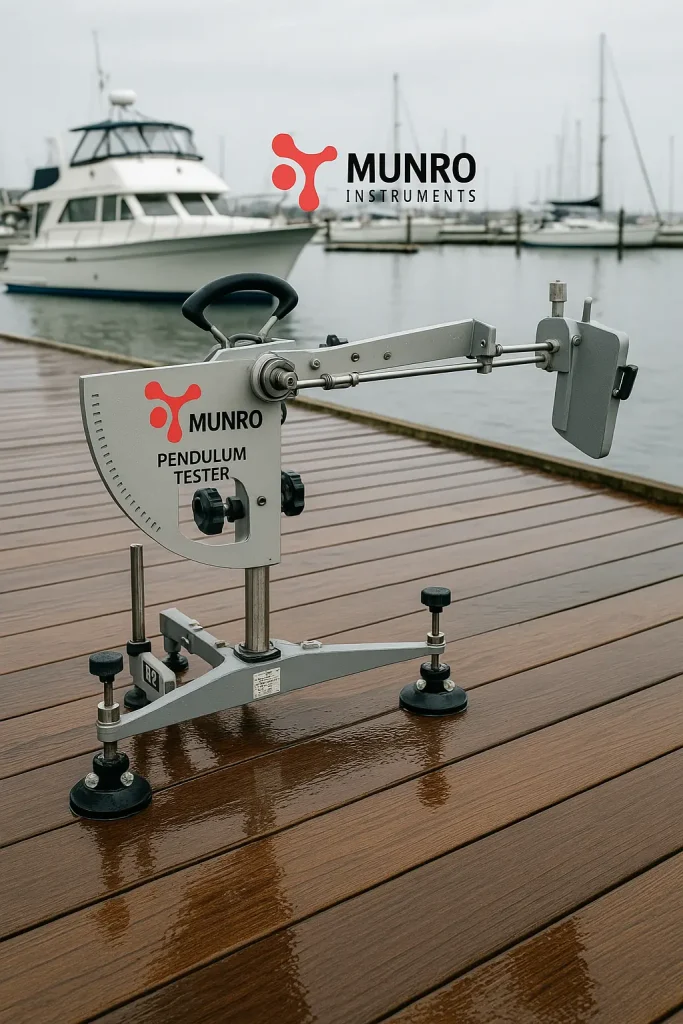
- ASTM E303 relies on the Pendulum Tester and is appropriate for smooth or moderately textured surfaces.
- ANSI A326.3 is the primary American standard for DCOF testing using a tribometer. It is appropriate for ceramic tiles, commercial interiors, and any setting requiring dynamic friction data.
- AS/NZS 4586 is common in Australia and New Zealand and is ideal for R-rating classification on ramps, external areas, and high-risk environments.
Selection is based on how closely the standard reflects real-world conditions for your floor type, contamination, and regulatory expectations.
What is the difference between measuring the Static Coefficient of Friction (SCOF) and the Dynamic Coefficient of Friction (DCOF), and which value is more relevant for pedestrian safety?
- SCOF measures friction at rest.
- DCOF measures friction during motion and is typically more representative of walking, slipping, and real-world pedestrian behavior.
DCOF is generally preferred for safety assessments, especially under ANSI A326.3 and similar standards.
Which testing device will be used (Pendulum Tester, Tribometer/BOT-3000E, Ramp Test), and what are the limitations of that device for my surface?
- Pendulum Tester works well on wet and dry floors, indoor and outdoor. Limitations: less suitable for deep carpet or extremely soft surfaces.
- BOT-3000E Tribometer measures DCOF to ANSI A326.3. Limitations: less accurate on highly textured or uneven surfaces.
- Ramp Test (R-rating) is excellent for heavily contaminated or industrial environments. Limitations: cannot be performed on-site and requires laboratory samples.
The device is selected based on your floor material, texture, hardness, and contamination risk.
If the Pendulum Test is used, which rubber slider (Slider 96 or Slider 55) will be applied, and how will it simulate the expected traffic?
- Slider 96 simulates standard shoe soles, suitable for most commercial and public areas.
- Slider 55 simulates barefoot traffic, used for pools, spas, changing rooms, and wet leisure environments.
The selected slider corresponds to real-world user footwear and environmental conditions.
Does the service offer testing under “worst-case” contamination (soap, oil, grease) in addition to water?
Yes. If your environment involves kitchens, industrial workshops, automotive areas, or wet leisure facilities, testing with additional contaminants can be included. Worst-case testing provides the most realistic risk profile.
What is the minimum acceptable slip resistance value for my application according to standards?
The threshold depends on the standard and environment. Typical requirements:
- Pendulum (PTV)
- Wet internal floors: PTV ≥ 36
- External pavements: PTV 38 to 45
- Wet barefoot areas: PTV ≥ 45
- ANSI A326.3 DCOF
- Internal level floors: DCOF ≥ 0.42
- AS/NZS 4586 (R-rating)
- R10: General internal areas
- R11 to R13: High-risk, wet or oily environments
Values vary by country, material, and risk category.
How are the final results reported, and is a certified report provided?
Results are reported as:
- Numerical score (PTV, DCOF, R-rating)
- Pass or fail classification
- Test conditions and contamination type
Certified reports are provided and accepted by insurers, facility managers, and legal entities for compliance verification.
How does the test account for direction of travel or slope angle?
For sloped surfaces:
- Pendulum readings are taken parallel and perpendicular to the direction of travel.
- Ramp tests provide an inclination angle classification.
Results include directional sensitivity and slope correction factors if applicable.
If the surface fails, what remedial actions are recommended, and is re-testing available?
Recommended actions may include:
- Anti-slip coatings
- Chemical micro-etching
- Surface restructuring
- Replacement of unsuitable materials
Re-testing is available after treatment to confirm compliance.
Is a surface roughness measurement (Rz value) included, and how does it correlate with slip resistance?
Roughness (Rz) is often measured to understand micro-texture. Higher Rz generally correlates with improved wet slip resistance, but not always. Combining Rz with PTV or DCOF provides a more complete risk assessment.
Does the service conduct on-site testing, or must I provide laboratory samples?
Most slip testing is conducted on-site, especially for existing buildings. Laboratory testing is used for new products, batch certification, or ramp testing.
What preparation steps must I take before the technician arrives?
- Clean the surface thoroughly using a neutral detergent.
- Remove all loose debris.
- Avoid applying sealants or coatings unless planned.
- Do not clean with highly alkaline chemicals within 24 hours before testing.
Proper preparation ensures reliable and repeatable data.
How many test locations are required for a statistically reliable result?
Typical guidelines:
- Small rooms: 3 to 5 test spots
- Large areas: 1 test per 10 to 20 square meters
- Batch materials: Minimum 3 samples
More locations are recommended for textured or variable surfaces.
What is the accreditation status of the lab or technicians, and why does it matter?
Look for:
- UKAS accreditation (UK)
- ISO 17025 compliance
- NATA accreditation (Australia)
Accredited services ensure impartiality, technical competence, and legally defensible results.
How does accelerated wear testing simulate long-term performance, and is this available as an add-on?
Accelerated wear uses controlled abrasion cycles to replicate years of foot traffic. It predicts long-term slip resistance and helps identify maintenance or material durability issues. Many services offer this as an optional add-on.
What is the specific Pendulum Test Value (PTV) floor safety benchmark recommended by the UK’s Health and Safety Executive (HSE) for a low slip potential on a level floor in wet or contaminated conditions?
According to HSE and UKSRG guidance, the official benchmarks are:
- PTV 0 to 24: High slip potential
- PTV 25 to 35: Moderate slip potential
- PTV 36 or above: Low slip potential
For wet or otherwise contaminated conditions on a level pedestrian walkway, PTV ≥ 36 is the formal threshold required to classify the floor as having a low slip potential. This benchmark is used by courts, insurers, auditors, and safety consultants throughout the UK.
What is the HSE/UKSRG guidance on the recommended re-testing interval for floor surfaces in a typical UK workplace, and for high-risk areas like commercial kitchens or entrances?
Re-testing intervals depend on traffic load, contamination risk, and maintenance conditions. UKSRG and HSE typically recommend:
- Standard workplaces such as offices, retail spaces, dry corridors
Retest every 12 to 24 months, depending on usage and cleaning regimes. - High-risk environments such as commercial kitchens, food preparation areas, wet entrances, changing rooms, external walkways
Retest every 6 to 12 months, or sooner if surface wear is accelerated. - Very high-risk or highly variable environments such as swimming pool edges or industrial areas
Retest every 3 to 6 months.
Frequent testing provides documented due diligence and ongoing compliance with UK best practice.
When testing a floor for general pedestrian use in the UK, will you use the Slider 96 (Four S rubber) or the Slider 55/57 (used for barefoot areas), and why is the distinction important for our environment?
- Slider 96 (Four S rubber) is the standard slider used across the UK for assessing floors in environments where people wear footwear. It is the correct choice for offices, retail, airports, stations, shopping centres, restaurants, and most commercial buildings.
- Slider 55 or Slider 57 is used for barefoot areas, particularly wet leisure facilities such as pool surrounds, spas, changing rooms, shower areas, and health clubs.
The distinction is critical because each slider represents a different frictional pathway:
- Slider 96 replicates the frictional properties of standard shoe soles.
- Slider 55/57 replicates soft, barefoot skin in wet environments where hydroplaning can occur.
Using the wrong slider results in misleading classifications and can invalidate compliance with UKSRG and HSE expectations.