
Slip accidents are one of the most preventable causes of workplace injuries, yet they remain among the most common across the UK. The Health and Safety Executive places heavy emphasis on measurable slip resistance, and any business operating a public or employee-accessible space must understand exactly what the HSE expects. This guide breaks the topic down clearly, practically, and in a way that every UK business can act on immediately.
Slip accidents as a leading cause of workplace injuries
Slips and trips consistently account for a large percentage of major injuries in the UK. These incidents often result in fractures, sprains, lost workdays, long insurance claims, and in serious cases, permanent disability.
Legal duties for employers under UK law
The Health and Safety at Work Act requires employers to create a safe environment for employees and visitors. That includes ensuring flooring provides adequate grip under realistic conditions like water, oil, or everyday contamination.
The financial impact of poor slip resistance
A single slip injury can cost a business thousands in claims, lost time, compensation, and potential enforcement action. Poor slip resistance is not just a safety issue, it is a financial liability.
The HSE’s Core Guidance on Slip Resistance
The importance of objective measurement
The HSE is clear: you cannot assess slip resistance visually or by touch. Objective, repeatable testing is the only valid method.
What the HSE considers a scientifically valid test
A test must measure friction under realistic heel strike conditions, offer repeatable data, and be replicable across sites and surfaces.
Why the pendulum test is the HSE’s gold standard
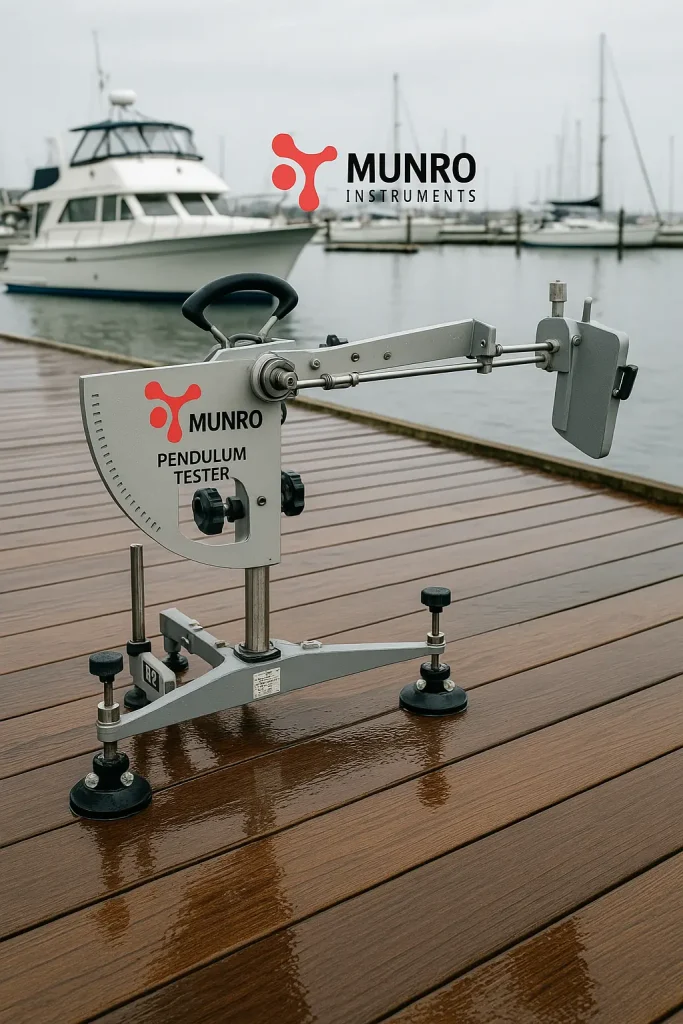
The pendulum tester is the only method the HSE formally endorses. It is used in UK courts and is recommended by both the HSE and UKSRG due to its accuracy and ability to measure wet conditions, the most common cause of slips.
Key Slip Resistance Standards Recognised in the UK
BS EN 16165 and its role
This standard specifies test methods for surfaces intended for pedestrian use and forms part of modern UK slip assessment.
UKSRG guidelines
The UK Slip Resistance Group offers practical guidance that fully aligns with HSE expectations.
How international standards compare
Standards like ASTM E303 or ANSI A326.3 offer useful data, but the HSE does not use them for legal or regulatory evaluation. The pendulum test remains the UK’s definitive method.
HSE Approved Testing Methods
The pendulum tester PTV scale
PTV thresholds
- 0 to 24: High slip potential
- 25 to 35: Moderate slip potential
- 36+: Low slip potential (HSE’s minimum safe benchmark)
Slider selection: Slider 96 vs Slider 55
When to use each slider
- Slider 96: Standard for shod pedestrians
- Slider 55: Used for barefoot areas (pools, spas, changing rooms)
Using the wrong slider invalidates results.
Surface microroughness analysis
Microroughness supports pendulum data by explaining how a surface interacts with water film and contaminants.
Why it matters
A smooth surface may still achieve high PTV values, while a rough one may fail depending on cleaning and wear.
Understanding the HSE’s View of the Pendulum Test
Replicates a human heel strike
The pendulum simulates the slip of a human heel at the moment of contact with the floor.
Works in wet and dry conditions
The HSE values the pendulum because it accurately measures performance when surfaces are contaminated.
Why other devices are not endorsed
Tribometers used in other countries cannot replicate heel strike mechanics and produce inconsistent results, especially in wet conditions.
Retesting Recommendations According to HSE and UKSRG
Routine workplace retesting
Most businesses should retest annually.
High risk zones
Entrances, kitchens, supermarkets, and industrial areas may require testing every 3 to 6 months depending on traffic and contamination.
After maintenance or contamination
Any major cleaning, resurfacing, or chemical contamination warrants fresh testing.
Common Mistakes UK Businesses Make
Relying on product datasheets
A floor that performed well in a factory setting may behave very differently in real-world conditions.
Using incorrect sliders
Incorrect slider choice can lead to misleading or non-compliant results.
Cleaning practices that reduce slip resistance
Some chemicals leave residues that make the floor more slippery than before.
Assuming textured flooring is always safe
Texture alone does not guarantee slip resistance, especially when wet.
Compliance and Legal Responsibility
Demonstrating due diligence
Documented pendulum testing is one of the strongest forms of evidence a business can present.
When businesses are liable
If a slip occurs and no objective testing was performed, a company can be held legally responsible.
How HSE inspectors evaluate floors
Inspectors rely heavily on PTV values, microroughness, and contamination risk.
Improving Slip Resistance Based on HSE Guidance
Cleaning as a control measure
Correct cleaning is often the most cost-effective way to improve slip resistance.
Treatments and coatings
Anti-slip coatings and etching treatments can dramatically raise PTV values.
Surface replacement
If a floor cannot be restored to a safe level, full replacement may be required.
Staff training
Employees should understand how spills, footwear, and cleaning affect slip risk.
Why Working With a Professional Slip Testing Service Matters
Legally defensible results
Professional testing provides documentation accepted in UK courts and by the HSE.
Correct methodology
Certified testers ensure correct slider choice, contamination simulation, and measurement accuracy.
Early risk detection
A professional test identifies problems before they escalate into incidents.